


 Technical Implementation
Most XCRI development to date has been carried out through JISC-funded, UK-oriented projects aimed to establish an XML specification to support the eXchange of Course Related Information. Learning providers can publish their courses information in the standard XCRI-CAP format, so that it can be collected easily by organisations with course aggregation services. Opening up the offerings of learning providers creates new possibilities for value-added services and information channels for universities, colleges, and training providers.
Schemas and Information Models: Includes XCRI-CAP versions 1.2 and 1.1 and mappings between them.
Examples and Code: Examples and code samples, using several different technologies.
Tools: Software applications and prototypes relating to XCRI.
Resources: The resources section can be sorted by a number of fields. To choose a particular category of resource, click on the Main Categories column header and scroll down to that type of resource.
Technical wiki: The XCRI wiki contains invaluable information about all the versions of the XCRI information models and a variety of bindings. It also shows how the XCRI-CAP standard has developed.
Architecture
The technical architecture of XCRI-CAP can have a very simple web-based approach. We describe a simple method here. Some producers may wish to use web services or alternative techniques.
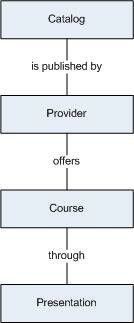
Providers (such as universities, colleges and training providers) each offer an XML document formatted according to the XCRI-CAP specification and a particular binding, using a standard web server. Aggregators (such as search, discovery or guidance services) periodically poll each provider to obtain the latest version of their catalog using a standard HTTP GET request. The aggregator merges the results to create a combined catalog to use for searching and for adding features.
Producing XCRI-CAP data
Providers can create XCRI-CAP catalog documents by collecting together their marketing information about courses and describing them in a single XML document or a series of them. XCRI-CAP catalogs can be hosted using any web server as a single static document, or can be generated dynamically, or can be offered through a content management system.
XCRI-CAP catalogs can contain a "generated" date attribute to help aggregating services to check whether a catalog has been modified. For most organisations existing tools can be used to generate XCRI-CAP catalogs - no new software systems or packages are necessary. A script can generate the necessary XML from a combined data view.
A single XCRI-CAP catalog can be used to supply course information to multiple aggregators. By using encoding schemes (vocabularies or controlled text), a single catalog can contain special data collection elements needed by particular agents (such as proprietary codes and identifiers) without affecting its use by other services.
XCRI r1.0
Some activity has been carried out during 2010 and 2011 in relation to using the original XCRI r1.0 release in curriculum management and curriculum planning. The Supporting Responsive Curricula (SRC) project produced a set of generic stakeholder requirements for an academic programmes database, based on XCRI r1.0, and the Cumulus project mapped Unit4's ACMS product data to XCRI r1.0, in order to trial a web service of XCRI r1.0 outputsValidation
To help providers the XCRI community offers online test aggregators and validators that you can use to view your data, check whether it conforms to the XCRI-CAP specification and compare it with the XCRI-CAP data offered by other providers.
